

Every year, Ivy Tech creative writing students have the opportunity to step away from the demands of everyday life, wander somewhere special and unfamiliar, and just see what happens when they finally have room to think.
Their destination is New Harmony, Indiana – a small historic community along the Wabash River known internationally as a destination for writers, artists and creative thinkers. It is a place of gardens, museums, striking architecture and the remains of two early 19th-century utopian communities.
For students enrolled in Ivy Tech’s eight-week creative writing course, it also becomes a living source of inspiration.
In July, the program “Writing in Harmony” completed its 12th creative writing retreat to New Harmony. The “rich experience” is the “most exciting thing,” Watson says she does every year.
“It’s such a rich experience,” Emily Watson started. Watson has spent 15 years as a full-time faculty member in Ivy Tech’s English department. “We don’t have a lot of experiences like this at Ivy Tech where students can have an intense connection with colleagues who they don’t know very well. Getting on this little Ivy Tech bus and going three hours from home is a real leap of faith for our students,” she continued. “But then they get there, and it’s just incredible. Maybe it’s being isolated; maybe it’s having this shared experience. But they come together as a group so quickly.”
“It’s such a rich experience. It’s the most exciting thing I do all year!”
– Emily Watson, English Faculty, Ivy Tech Indianapolis
From reluctant travelers to a community of writers
The Writing in Harmony trip first began in 2015. When Ivy Tech’s honors students needed an affordable travel experience, Watson suggested New Harmony, a small town with a population of fewer than 700 people, according to the 2020 U.S. census. Just three hours from her hometown of Indianapolis, Watson first visited when she was a student.
The idea was not initially met with much enthusiasm.
Students had hoped to visit Chicago. Watson, then a new instructor, saw New Harmony as a safer and more manageable place for students to learn how to navigate an unfamiliar community. At roughly a mile across, the town could largely be explored without vehicles. During the program’s earliest years, even students’ cellphones did not always work there.
They had to carry maps, speak with residents, and find their way around. Then something welcomingly unexpected happened: The students loved it.
“The student excitement is what has kept the retreat going. Once we get there every year, it’s just so exciting to see how positively the students react to the experience,” Watson shared.
Over time, the retreat became more deeply focused on writing. During the first six weeks of the course, students complete IvyLearn coursework and develop their creative writing and research skills. In Week 7, they travel to New Harmony, where they spend five days gathering ideas, experimenting with their craft, and finding creative renewal. By the end of the course, each student develops one idea from the retreat into a completed piece.
Students may write poetry, prose, travel journals or other forms of creative work. They learn about imagery, sensory details and the elements of effective writing before considering how their surroundings can inspire something new.
“They have to write every day while they’re in New Harmony, but it’s casual prompts,” Watson explained. “They have to start things. Then their final project is to finish one of the things they started and turn it into a complete work of writing connected to their time in New Harmony.”
Giving students room to notice
A typical day blends history, art and structured writing time. Students may begin with a historical talk or tour, spend the afternoon learning from a local artist or writer and later reflect on what surprised them.
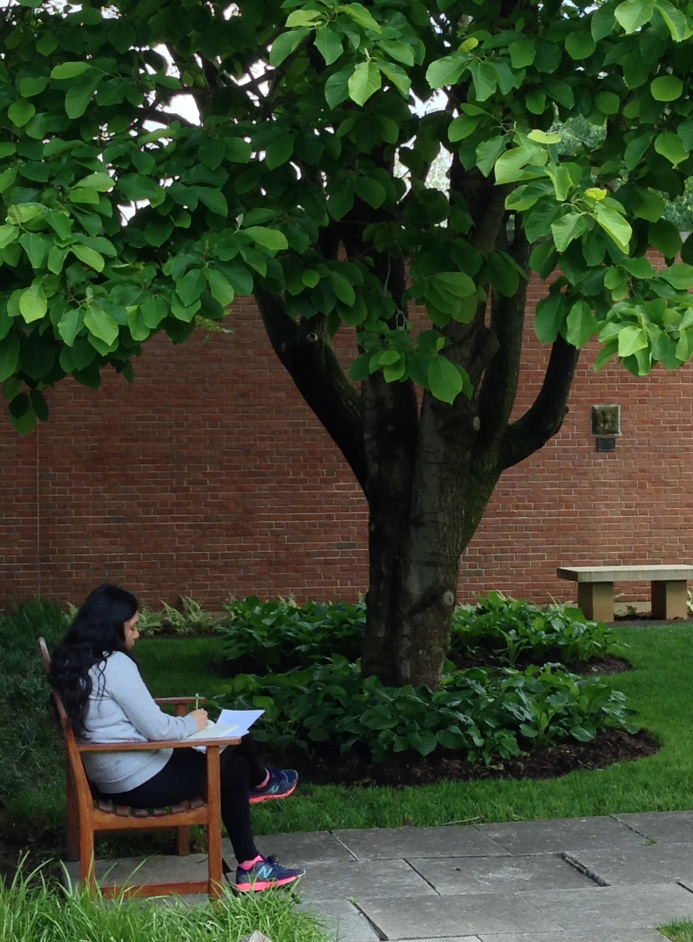
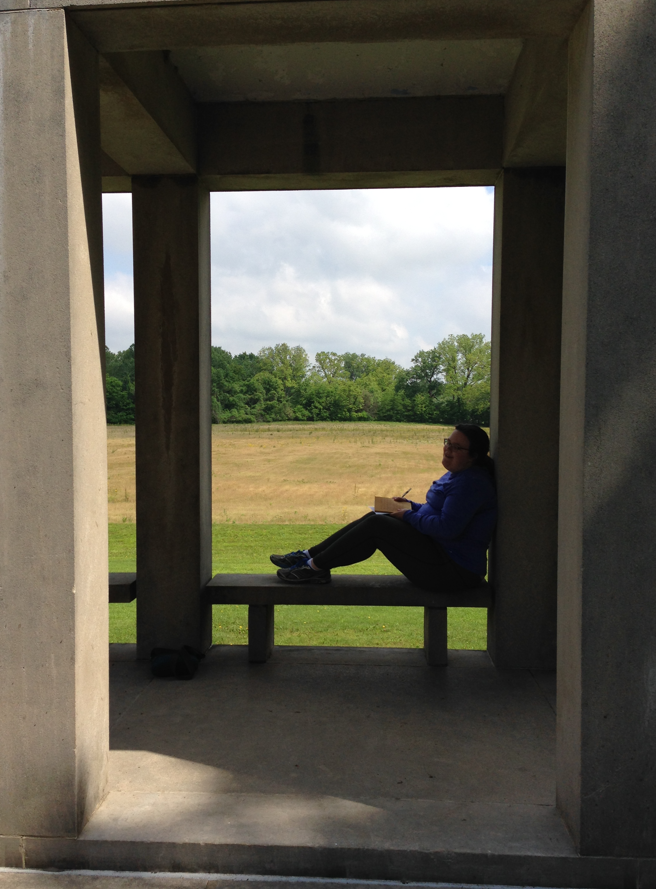
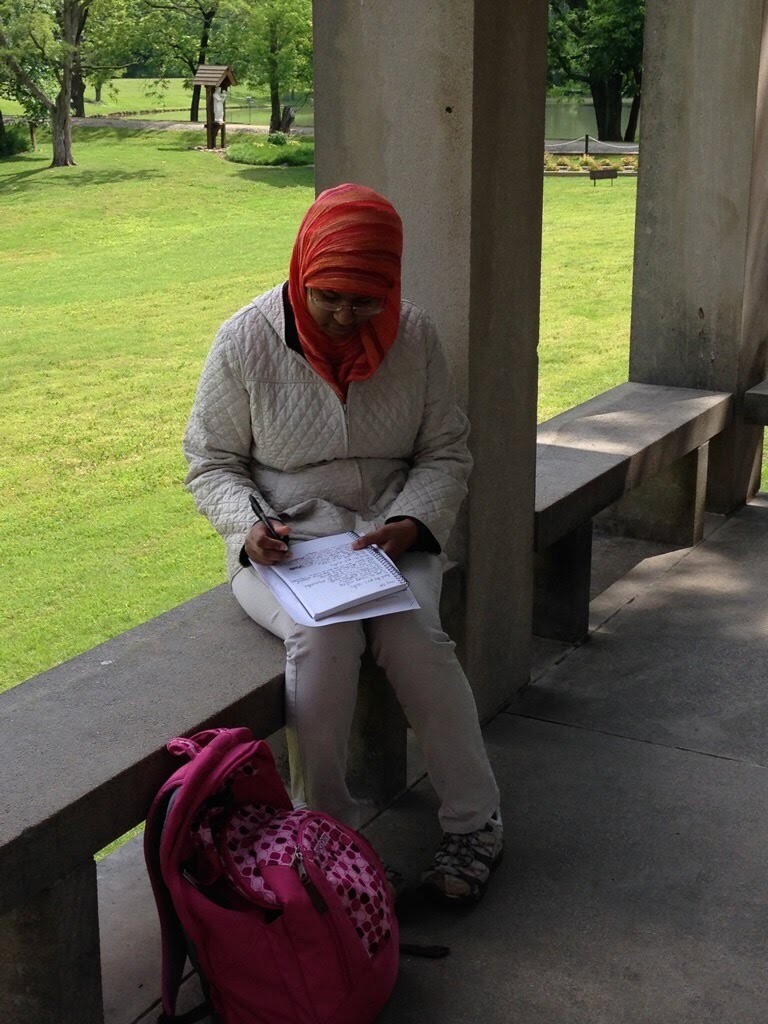
Watson and Chris Luter – another English faculty member who has co-taught the course for the last eight years alongside Watson – offer prompts and invite students to choose a place to write. Some explore together. Others find a solitary spot in a garden, along the river or near one of the town’s architectural landmarks.
Among the places students consistently connect with is the Roofless Church, designed by architect Philip Johnson as an open-air space intended to unite visitors beneath the sky. Students also explore the town’s labyrinths, museums, gardens and historic sites.


The surroundings are important, but Watson believes the retreat’s greatest gift may be time—something many students rarely have in abundance.
At home, students may be balancing classes with jobs, children, emails and other responsibilities. In New Harmony, those expectations temporarily fall away.
“When I’m away from my kids and from my email and all of these other things, I suddenly have the mental real estate available to connect with people in different ways and to look around the world in different ways,” Watson said. “There’s no real choice but to go and explore and sit in a garden and see what happens.”
Watson hopes students learn that creative renewal does not always require traveling for five days. They can reproduce part of the experience by putting down their phones, visiting an unfamiliar place, or simply giving themselves an hour to notice what is around them.
“I hope they discover that you can find inspiration anywhere if you are giving yourself the space to notice stuff,” Watson said. “We feel like we have to be productive all the time. Seeing how this feels for five days shows us that we know how to make it happen again.”
A five-day experiment in community
Students often begin the trip as strangers. Coming from different campuses and communities, many arrive unsure about spending five days with people they have only encountered online.
Watson describes boarding the Ivy Tech shuttle and traveling three hours from home as “a real leap of faith” for some students.
Once they arrive, however, the group often forms connections quickly. Students experience the same places, share meals, respond to one another’s writing and learn how to navigate an unfamiliar environment together.
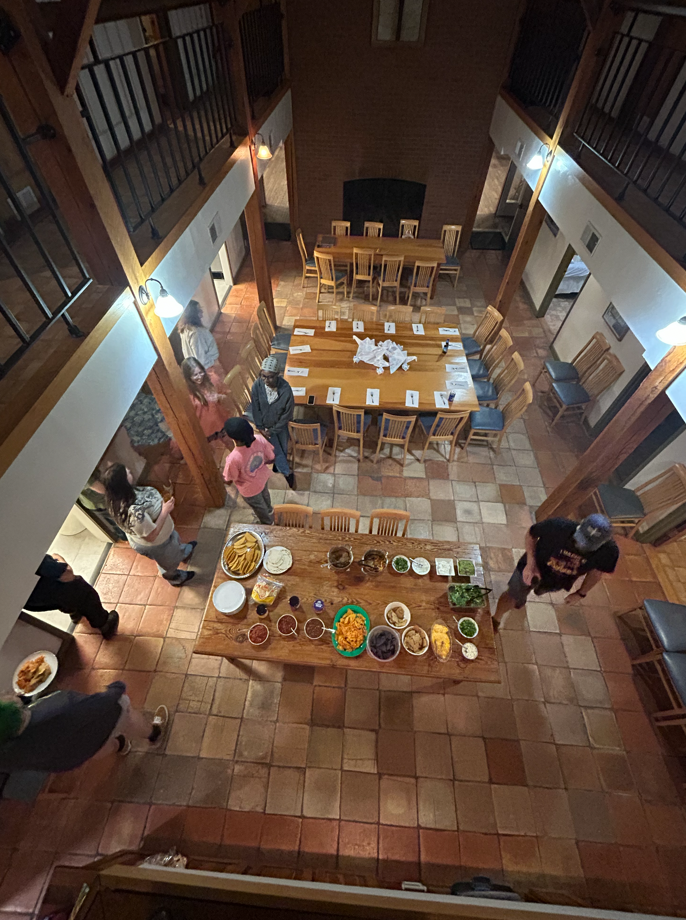
One retreat tradition asks students to prepare a group dinner without help from their instructors. Watson and Luter provide the groceries and suggest a menu, but the students must decide how to organize themselves.
During the 2026 retreat, students transformed a simple taco-bar assignment into a creative undertaking. They made origami decorations from leftover paper, rearranged the tables, selected a DJ and taught one another how to prepare the meal, including showing one classmate how to chop an onion for the first time.
“All they had to do was make a taco bar. They didn’t have to do anything fun,” Watson joked. “It was their creative culinary endeavor and their creative community endeavor. They reinvented the space.”
The activity reflects the history students study in New Harmony. Both utopian communities built in the town centered on shared resources, collective work, and what people could accomplish together.
“We have a little five-day experiment with that ourselves,” Watson said.
That sense of community often extends beyond the retreat. Former participants have organized reunions, picnics, museum visits and camping trips. Others still respond when Watson shares information about the course online, telling her years later that the retreat was among their most meaningful experiences at Ivy Tech.
New surroundings, new stories
The work produced during the 2026 course reflected the range of inspiration students found throughout New Harmony.
After learning about the Minerva Society, a 19th-century intellectual group for women, one student wrote a humorous short story imagining not only the group’s discussions of science and politics but also the interpersonal dynamics that might have unfolded behind the scenes.
Other students created travel journals or paired their writing with drawings inspired by New Harmony’s historic communities and architectural spaces. One completed a visual poetry project.
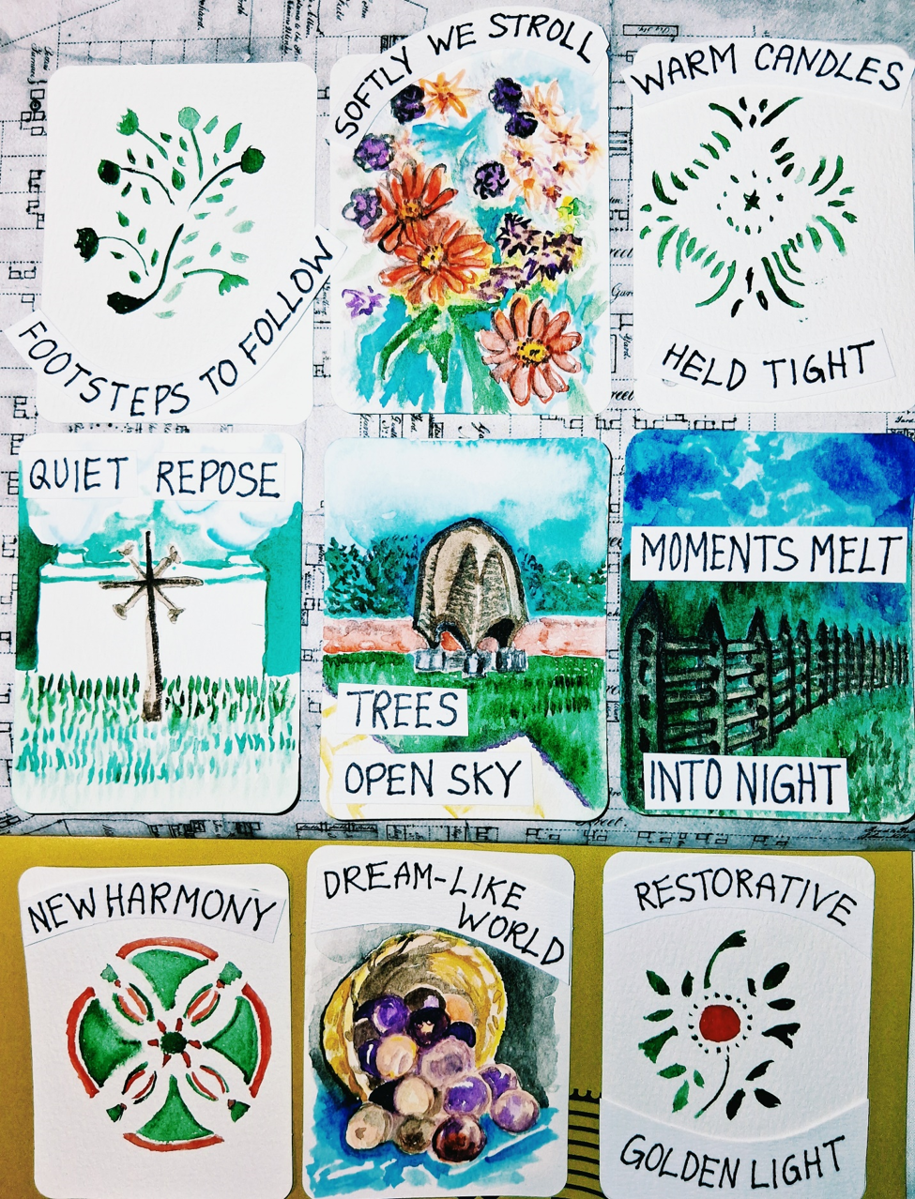
Across their work, Watson noticed recurring themes of nature and community. Students wrote about walking together along the river and seeing more fireflies than they had ever encountered before.
But the experience teaches them more than how to find their next story. It shows them that they can enter a new place, connect with unfamiliar people and take a chance on something they may not fully understand yet.
“There’s always interesting history to learn about a community and interesting ways to connect with a community,” Watson said. “We figure out how much we can go and learn—and that we have the ability to take a risk, and it will be OK.”
The retreat in 2026 was fully funded through support from Circle of Ivy, advancing accessibility and affordability for participating students. Students are responsible only for course tuition, with no additional trip expense.
For Watson—who says she has always wanted to work at Ivy Tech—that support preserves an opportunity that may otherwise be out of reach for many students and makes space for one of Ivy Tech’s smaller but deeply meaningful learning experiences to continue inspiring writers.
“I love our students. We have the most interesting students I’ve ever taught. They bring so many cool experiences. I liked teaching at a traditional college, but I learn so much more from our students,” Watson said. “Once I decided to be a teacher, I thought that Ivy Tech would be the right place for me. And it was.”
Learn More About Writing in Harmony & Enroll
About Ivy Tech Community College
Ivy Tech Community College is Indiana’s largest public post-secondary institution and the nation’s largest singly accredited statewide community college system. Ivy Tech serves more than 200,000 students annually and offers associate degrees, certificates, and workforce training in more than 70 programs across Indiana. The College is accredited by the Higher Learning Commission and is committed to providing affordable, high-quality education aligned with the needs of Indiana’s workforce.


